The 3-Question Rule That Stops Circling From Killing Your Class
Stop over-circling and losing your class. The 3-Question Rule gives CI teachers an exact sequence to cap circling, keep students engaged, and move on at the right time. Practical, classroom-tested, ready to use tomorrow.

You Already Know This Feeling
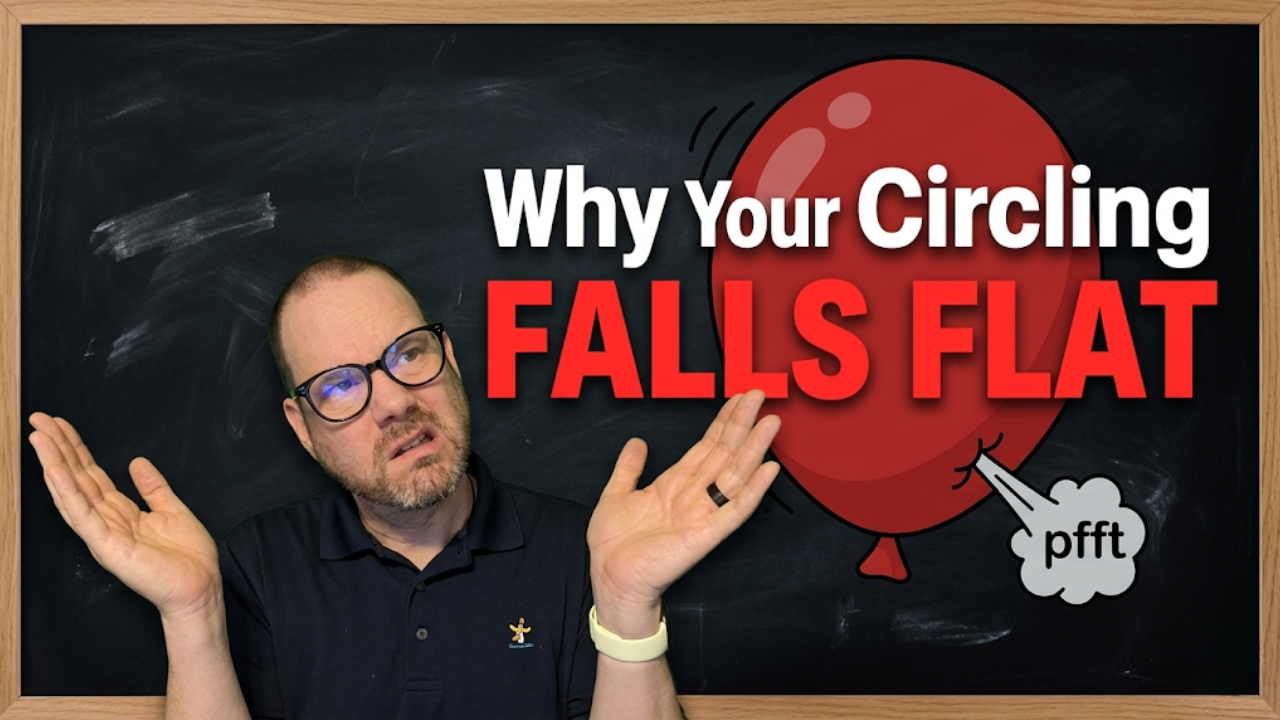
You're mid-lesson. You've established a beautiful structure — tiene un gato — and you're circling like a pro. "¿Tiene un gato?" Sí. "¿Tiene un gato o un perro?" Un gato. "¿Quién tiene un gato?" And then... you keep going. "¿Tiene un gato grande o un gato pequeño?" "¿Cuántos gatos tiene?" You look up. Half the class is staring with the same dead-eyed expression they reserve for standardized testing. Two kids in the back are having a full conversation about lunch. One kid is openly asleep — and you can't blame her.
You over-circled. Again.
Here's the thing nobody tells you in CI training: circling is one of the most powerful comprehension tools we have, and also one of the easiest to run into the ground. The technique itself is simple. The discipline to stop? That's the actual skill. And most of us — myself included, for an embarrassing number of years — default to "more is better" because we're terrified students didn't get enough reps. So we circle until the room goes cold and then wonder why our CI class feels like a deposition.
The fix is almost stupidly simple: cap it at three questions per statement, then move on. That's the rule. Three questions. Not five. Not "until they get it." Three. And within those three, there's a specific sequence that maximizes comprehension while keeping the energy alive. Let me walk you through exactly how this works, what it looks like when it breaks, and how to make it automatic by next week.
Three Questions Is Not a Suggestion — It's a Survival Mechanism
Let's start with why three. It's not arbitrary, and it's not because some researcher said so in a paper you'll never read. It's because three questions, structured correctly, give you three different types of processing — and that's all most students need before the input starts to calcify or evaporate.
Here's the sequence:
- Yes/No — "¿Tiene un gato?" (Confirms meaning. Low-risk. Everyone can participate.)
- Either/Or — "¿Tiene un gato o un perro?" (Forces comparison. Slightly higher processing.)
- Open-Ended — "¿Quién tiene un gato?" or "¿Qué tiene?" (Requires retrieval. Highest processing.)
That's your arc. Confirm → Compare → Retrieve. Three reps of the target structure, three levels of cognitive demand, done in under 45 seconds. Then you move. You add detail, pivot to PQA, or advance the story. You do not ask a fourth question about the cat.
The classroom scenario: You're circling va a la tienda with your Spanish 1 class. You ask: "¿Va a la tienda?" Class responds. "¿Va a la tienda o va a la escuela?" Class responds. "¿Adónde va?" A few strong students answer. You see one kid in row three squinting — he's processing but hasn't answered out loud. Your instinct screams ask another question so he gets it. Don't. Move to the next beat: "Va a la tienda... ¡y compra chocolate!" Now you circle compra chocolate. That kid in row three just got another exposure to va in a new context — which is worth more than question number four about the same sentence.
The common mistake: Asking "just one more" to make sure the slow processors caught up. I get it. You care. But that one more question is almost always for you, not for them. You're soothing your own anxiety. Meanwhile, the fifteen kids who got it on question one are now disengaging, and you've taught them that CI class means sitting through repetition that isn't for them. Fix: trust the spiral. The structure will come back — in the next sentence, in the story, in the reading, in tomorrow's warm-up. Three questions now. More exposure later. That's the system.
The tool — The 3Q Sticky Note:
Write this on a Post-it and stick it where you teach:
□ Yes/No
□ Either/Or
□ Open (who/what/where)
→ MOVE ON
Check each box mentally as you go. When you hit three checks, the arrow is your cue. Physical, visual, impossible to ignore. I've used this for years. It works better than willpower.
Reading the Room Is the Real Technique (Circling Is Just the Vehicle)
Here's a truth that took me way too long to learn: the best circlers aren't the ones who ask the best questions. They're the ones who stop at the right time. Circling is a delivery mechanism. Room-reading is the skill. And if you can't read the room, three questions might even be too many.
What does "the room is dying" actually look like? Not the dramatic version — nobody's throwing things or walking out. It's subtle. It's the kid who answered enthusiastically on question one giving you a flat "sí" on question two. It's three students suddenly finding their pencils fascinating. It's the overall volume of choral response dropping by half. It's the vibe shift you feel in your gut before you can name it.
The classroom scenario: You're doing a PQA warm-up. You ask Jaylen if he has a dog. He lights up — he loves his dog. You circle: "¿Jaylen tiene un perro?" Huge class response. "¿Jaylen tiene un perro o un gato?" Still strong. You're about to ask the open-ended question, but you notice something: the energy is already peaking. Jaylen is grinning, kids are engaged, the vibe is up. So instead of asking question three, you pivot: "¡Jaylen tiene un perro! ¿Cómo se llama?" Now you've moved into PQA territory. You skipped the third circling question because the room told you they didn't need it. That's not breaking the rule — that's mastering it. Three is the cap, not the quota.
The common mistake: Treating circling like a checklist you must complete regardless of what's happening in front of you. If the room tells you they got it after one question — move. If they're lost after three, don't circle a fourth time. Slow down, re-establish meaning, use a gesture, point to the word wall, translate. More questions aren't always more comprehension.
The tool — The 3 Death Signals Checklist:
Before your next class, identify your three personal "bail now" signals. Write them down. Here are common ones to get you started:
MY BAIL SIGNALS:
- Choral response volume drops noticeably
- More than 3 students break eye contact simultaneously
- Answers become echoey/robotic (they're parroting, not processing)
WHEN I SEE ONE: Skip remaining questions → advance the narrative or pivot activity
WHEN I SEE TWO: Stop circling entirely → switch to gesture/TPR/brain break
Tape this next to your 3Q sticky note. Now you have a gas pedal and a brake.
The Procrastinator, the Grade-Grubber, and the Ghost: Circling With Real Teenagers
Theory is cute. Let's talk about what actually happens when you try this with actual human adolescents who have phones, hormones, and a deep commitment to doing as little as possible.
The Procrastinator: Marcus doesn't answer circling questions — not because he can't, but because effort is his mortal enemy. He sits in the back and lets the class carry the choral response. Over-circling is Marcus's paradise: the longer you circle, the more anonymous he gets. The 3-question rule moves fast enough that cold-calling Marcus on question two feels like the pace of class, not punishment. "¿Marcus, tiene un gato o un perro?" He answers. You nod, move on. Four seconds. The rule doesn't give procrastinators enough dead air to hide in.
The Grade-Grubber: Sophia needs to know if circling responses "count." She wants points, a rubric, and possibly extra credit for answering more. Over-circling feeds her anxiety because she's mentally tallying every response, turning comprehension into a performance metric. The 3-question cap helps because it's fast and low-stakes. When Sophia asks if this counts, you say: "This is how you learn the language. The grade takes care of itself." And because you're moving quickly, she doesn't have time to spiral.
The Ghost: Daniela was absent Monday through Wednesday. She's back with no context and no idea what tiene means. Over-circling doesn't help — it just gives her more questions she can't answer about a story she missed. The 3-question rule helps indirectly: you cover more ground per class, which means more varied contexts, which means Daniela picks up structures from new angles. Pair the rule with a one-minute recap at the start of class, and she re-enters the narrative without a make-up assignment.
The common mistake: Treating circling the same way regardless of who's in front of you. A class full of enthusiastic freshmen can handle three rapid-fire questions with energy to spare. A class of burnt-out juniors after lunch might need you to circle twice, max, and lean harder on reading or Write & Discuss. Same rule, different application. Three is the cap — not every class needs all three every time.
The tool — The Student Energy Quick-Read:
BEFORE circling, scan for:
→ High energy: Use all 3 questions, fast pace, cold-call freely
→ Medium energy: Use 2-3 questions, warm-call (give think time)
→ Low energy (post-lunch, Monday, testing week):
Use 1-2 questions max, then pivot to reading/writing activity
This takes two seconds. It prevents you from circling a room that isn't ready to be circled.
Circling Isn't Your Only Tool (Stop Making It Do Everything)
One reason teachers over-circle is because circling is comfortable. You know how to do it. It works. It fills time. And when you're not sure what else to do with a structure, circling is right there, reliable and familiar. But leaning on circling for all your reps is like eating only chicken for every meal — technically nutritious, absolutely soul-crushing after a week.
The 3-question rule works partly because it forces you to stop circling and do something else. That "something else" is where the magic happens, because varied repetition in different contexts is what actually builds acquisition.
After your three questions about va a la tienda, you could: add the next story beat, shift to PQA ("¿Tú vas a la tienda después de la escuela?"), do a quick choral translation, run a gesture check, or start a Write & Discuss segment. Each of these gives additional reps without asking a single additional circling question. The 3-question rule isn't about doing less — it's about doing different sooner.
If you're looking for a bank of ready-made structures, stories, and activities that pair well with efficient circling, the CI Survival Kit has been a go-to for a lot of teachers I work with. It's basically a toolbox so you're never stuck staring at a structure wondering "okay, now what?" after your three questions. But whether you use that or build your own, the principle is the same: circle tight, then pivot.
The classroom scenario: It's Thursday. You've been circling all week, and students are giving you that look — the one that says "if you ask me one more question about María's cat, I will transfer to French." The fix isn't to circle less. It's to circle the same amount but fill the surrounding space with variety. Monday: circle + story asking. Tuesday: circle + Picture Talk. Wednesday: circle + MovieTalk. Thursday: circle + Read & Discuss. Friday: free voluntary reading. Same three questions per structure, completely different class experience every day.
The common mistake: Confusing "efficient circling" with "less input." The 3-question rule doesn't mean fewer reps. It means reps from more sources. Students get more total exposure because you're not burning five minutes circling one structure when you could circle it in 90 seconds and spend the rest embedding it in a story, reading, or PQA.
The tool — The Post-Circle Pivot Menu:
After 3 questions, choose ONE:
□ Add a story beat (new information using same structure)
□ PQA pivot (personalize the structure to a student)
□ Choral translation (quick meaning check)
□ Gesture/TPR (physical response)
□ Write & Discuss (co-create written text)
□ Partner retell (students tell each other what happened)
Print this. Keep it on your desk. When you finish your third question, glance down, pick one, go.
Why Teachers Resist Capping (And Why You Should Do It Anyway)
Let me be real: the reason most CI teachers over-circle isn't ignorance. It's fear. Fear that students didn't get enough reps. Fear that the slow processor in row four will fall behind. Fear that you're being a bad CI teacher if you move on too quickly.
This fear is understandable. You've been told — correctly — that comprehensible input requires repetition. So your brain does the math: more questions = more reps = more acquisition. But there's a point of diminishing returns, and it hits sooner than you think. After a few focused exposures in quick succession, additional repetitions in the same format yield almost nothing. The brain says "got it, move on" — and if you don't, it tunes out. Those extra circling questions aren't being processed. They're being endured.
The classroom scenario: You're a second-year CI teacher. You went to a workshop, learned circling, and you are committed. You circle every structure at least six times because your trainer said "more reps." Your students are compliant but joyless. Your evaluator writes: "Good questioning technique. Student engagement could be improved." Here's what happened: you prioritized quantity of reps over quality of experience. Your students are getting repetitions in a context that feels like drilling — which is the exact thing CI was supposed to replace.
The common mistake: Conflating "more circling" with "better CI." Circling is one input strategy. It's not the whole methodology. The best CI teachers circle less than beginners because they've learned to distribute reps across multiple activity types. Cap your circling, diversify your input, and watch engagement come back. You're not abandoning CI. You're doing it better.
The tool — The Fear vs. Data Check:
When you feel the urge to ask a fourth question, pause and ask yourself:
FEAR CHECK:
Am I asking another question because:
□ Students genuinely seem confused → Re-establish meaning (don't circle again)
□ I'm worried they won't remember → Trust the spiral. It comes back tomorrow.
□ I don't know what to do next → Use the Pivot Menu (see above)
□ The silence feels awkward → That's YOUR discomfort, not their confusion
If you checked anything other than box one, move on. The urge to over-circle is almost always about your anxiety, not their acquisition.
How to Start Tomorrow
You don't need a workshop or a unit redesign. You need a sticky note and five days of intentional practice.
Day 1 (Monday) — Baseline: Teach your normal lesson but tally how many circling questions you ask per statement. Don't change anything — just count. If you're averaging 5-8 per statement, you're normal. You're also over-circling. Write your 3Q sticky note and tape it where you teach.
Day 2 (Tuesday) — First Attempt: Run your lesson with the 3-question cap. You will feel like it's not enough. That's the fear talking. When you finish your third question, glance at your sticky note and advance the story or pivot. If you accidentally ask a fourth, don't spiral — just move on faster next time.
Day 3 (Wednesday) — Add the Pivot: After every set of three questions, consciously choose one pivot from the Post-Circle Pivot Menu. Having a plan prevents the "uh, now what?" moment that leads to over-circling by default.
Day 4 (Thursday) — Read the Room: Same 3-question cap, but add room-reading. Before your third question, scan: are they still with you? If energy is flagging, ask two and pivot. Start using your Bail Signals checklist.
Day 5 (Friday) — Reflect: Teach with the rule running in the background. At the end of the day, compare how class felt this week vs. last week. Write one sentence: "Next week I'll adjust ___." That's your iteration loop.
By the end of five days, the 3-question cap should feel less like a constraint and more like a relief. You're not doing less work. You're doing more focused work — and your students can feel the difference.
When It Goes Sideways: Troubleshooting the 3-Question Rule
- "I keep accidentally asking 4-5 questions before I catch myself." Normal for the first two weeks. Move the sticky note closer to your eye line. Some teachers tape it on the document camera or to the back of their phone. The visual cue has to be in your sight line, not across the room.
- "My students seem confused even after three questions." Three circling questions is not three total exposures. If students are confused after circling, the structure wasn't established clearly enough before you started. Slow down your initial statement. Point to the word wall. Translate. Then circle. Circling confirms comprehension; it doesn't create it from scratch.
- "One class is fine with three questions, but my other class needs more." They probably don't need more circling — they need more input. After your three questions, do a longer retell, a partner check, or a choral reading. Different classes need different activity balances, not different circling quantities.
- "I feel like I'm rushing." You might be. The 3-question rule doesn't mean speed-circling. Take your time with each question. Pause. Let students process. Use wait time. Three well-paced questions with genuine pauses beat six rapid-fire questions every time. Speed kills comprehension.
- "My admin wants to see more student talk time. Won't capping questions reduce that?" The opposite. Over-circling produces teacher talk time disguised as interaction. Efficient circling opens space for PQA, partner activities, retells, and Write & Discuss — all of which generate authentic student output. If anything, the 3-question rule increases student talk by getting out of the way faster.
- "I teach heritage speakers / AP / upper levels. Does this still apply?" The principle scales. With advanced students, your three questions might be more complex ("¿Por qué crees que el personaje va a la tienda en vez de quedarse en casa?"), but the cap still prevents you from grinding one structure into dust. Advanced students lose patience with over-circling even faster than novices.
Here's What You Actually Need to Remember
Circling is powerful. Over-circling is poison. The difference between the two is about three questions.
You don't need to become a different teacher. You need a sticky note, a pivot plan, and the willingness to trust that three focused questions — followed by varied input activities — will do more for acquisition than eight repetitive ones. Your students will be more engaged. Your classes will move faster. And you'll stop having that sinking "I lost them" feeling at minute twelve.
The 3-question rule isn't a limitation. It's a permission slip to stop performing thoroughness and start teaching efficiently.
Five Key Takeaways
- Three questions per statement (Yes/No → Either/Or → Open-Ended) is the cap. It gives you three processing levels in under a minute. Anything beyond that is anxiety, not pedagogy.
- Reading the room trumps any rule. If they got it in two questions, move. If they're lost after three, don't circle again — re-establish meaning through other means.
- Over-circling is usually about teacher fear, not student need. The urge to ask "just one more" is you soothing yourself. Notice it. Override it.
- The 3-question rule only works if you have somewhere to go after. Build a pivot plan. Circle → story beat, PQA, gesture, Write & Discuss, retell. Circling is the on-ramp, not the highway.
- This takes five days to install, not five weeks. Sticky note on Day 1. Intentional practice through Friday. Iterate from there. It's the smallest change with the biggest payoff in your CI practice.