The One-Page Gradebook Reset That Finally Makes CI Grades Make Sense
A simple one-page gradebook reset that helps CI teachers create fair, clear grades—without overhauling everything. Fewer categories, less stress, and grades that finally match how language is acquired.

The Gradebook Reset CI Teachers Secretly Want
Let’s just name it. Most CI teachers aren’t burned out from teaching. They’re burned out from explaining grades that don’t match what they know about language acquisition. You can run a beautiful, human, input-rich classroom where students are actually acquiring language, and still have a gradebook that screams, “I was built for a worksheet economy.”
That disconnect is exhausting.
It shows up when students say, “But I understand everything,” while the grade says otherwise. It shows up in parent emails that begin with “We’re confused…” and end with you opening twelve tabs to explain a system that made sense at the time. It shows up when you hesitate to change anything mid-year because the gradebook feels like a Jenga tower and you are tired.
Here’s the good news. You don’t need a new philosophy, a new platform, or a new year. You need a reset. And not a weekend-long, color-coded, overhaul-your-life reset. You need a one-page reset. Something simple enough to understand at a glance and sturdy enough to survive reality.
This article is about doing exactly that—cleaning up your gradebook so it finally reflects how CI works, how students acquire language, and how fairness should actually function in a classroom full of humans.
Why CI Teachers Struggle With Traditional Gradebooks
Traditional gradebooks were designed for output-heavy classrooms. They assume learning is visible on demand, that effort looks the same for every student, and that accuracy equals understanding. CI teachers know all three of those assumptions are nonsense.
Comprehensible input works because it respects the invisible. Processing happens internally, unevenly, and on a timeline that laughs at quarterly grading periods. When we force that process into a gradebook built for constant performance, things get weird fast.
Suddenly we’re grading participation but also quizzes but also tasks but also formative checks that accidentally became summative because the system required a number. We end up with categories that made sense individually but collectively look like a buffet of anxiety.
The problem isn’t that you’re bad at grading. The problem is that your gradebook has never been introduced to how language acquisition actually works.
The Power of a One-Page Constraint
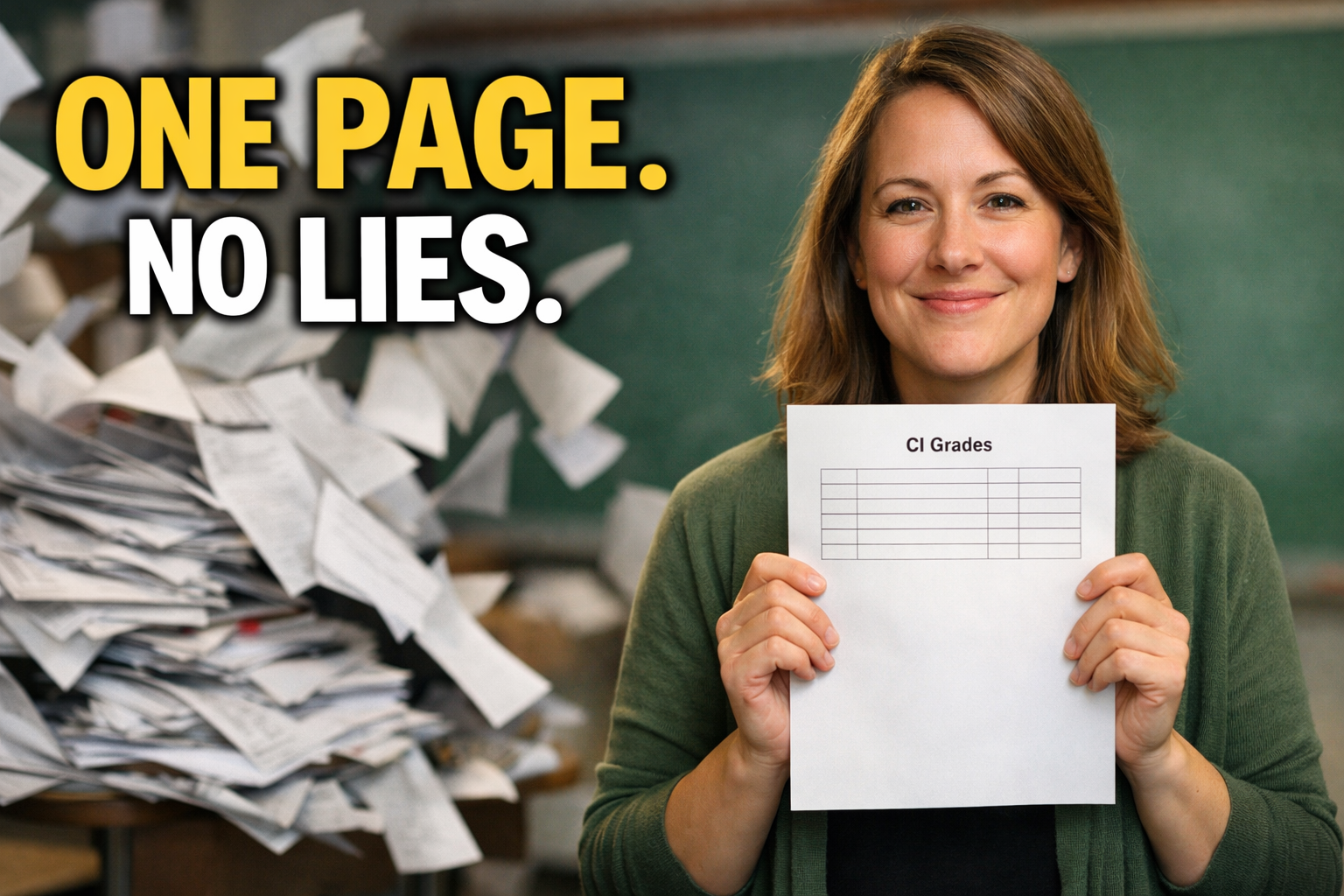
Here’s where the magic happens. When you force your entire grading system onto one page—physically or mentally—you are forced to make decisions. Real ones. You have to answer uncomfortable questions like, “What am I actually valuing?” and “Does this category exist because it matters or because it’s always been there?”
A one-page gradebook does not mean fewer grades. It means clearer grades. It means that when you look at it, you can immediately see what matters, what supports learning, and what exists purely to calm your inner rule-follower.
This constraint is powerful because it removes the hiding places. You can’t bury unfairness under ten subcategories. You can’t pretend something is important just because it has a column. If it’s on the page, it has to earn its spot.
And once that happens, clarity shows up everywhere else.
Resetting Categories Without Burning It All Down
Most CI teachers don’t need more categories. They need fewer, better ones. Categories should describe learning behaviors and evidence in plain language, not grading jargon. When students and parents read your gradebook, they should immediately understand what’s being measured and why.
This reset often starts by merging categories that are doing the same job under different names. If you have “Participation,” “Engagement,” and “Classwork,” congratulations—you have one category wearing three outfits. Choose one name and let it breathe.
The goal is alignment. Categories should reflect how students encounter language in your room. Listening and reading matter. Showing understanding matters. Occasional output matters, but not in a way that punishes developmental timing.
When categories align with reality, fairness becomes automatic instead of something you have to explain defensively.
Fairness Is Predictability, Not Equality
One of the biggest myths in grading is that fairness means treating everyone the same. CI teachers know better. Fairness means students know what counts, how it counts, and that their grade won’t swing wildly based on one off day.
A one-page reset makes patterns visible. When grades are weighted sanely and evidence is consistent, students stop feeling like the system is out to get them. They understand how their actions connect to outcomes, and that reduces anxiety almost immediately.
This is especially powerful for slower processors and students with anxiety. When grades reflect sustained comprehension over time instead of high-pressure snapshots, you get a system that measures growth without turning learning into a performance sport.
Fairness doesn’t shout. It reassures.
What to Remove First (Because You’re Not Keeping Everything)
If something in your gradebook makes you sigh every time you explain it, that’s your first candidate for removal. If you can’t describe a category without saying, “Well, it kind of…” it doesn’t belong on your one page.
Many CI teachers discover they are grading things they don’t truly believe in anymore. Busywork that stuck around. Assessments that exist because someone once asked for them. Tasks that were meant to motivate but now just clutter the system.
Removing those isn’t reckless. It’s responsible.
Your gradebook should tell the truth about your classroom. Anything that distorts that truth is dead weight.
How This Reset Changes Student Behavior
Here’s the quiet win nobody talks about. When grades make sense, students behave differently. They stop gaming the system because there’s nothing to game. They stop asking if everything is graded because the answer is obvious.
They listen more because listening matters. They read more because reading shows up. They stress less because they understand how learning accumulates.
And you? You stop negotiating grades like you’re haggling at a flea market. The system speaks for itself.
One Page, Fewer Emails
Parent communication gets dramatically easier after a reset like this. When grades are transparent, conversations shift from “Why is this happening?” to “How can we support?”
You can point to categories and patterns instead of individual points. You can explain philosophy once instead of apologizing weekly. The gradebook becomes a tool, not a liability.
That’s not just convenient. That’s sanity-saving.
When You’re Ready to Go Deeper
A one-page reset is the gateway move. It cleans things up and gives you immediate relief, but many teachers realize it also exposes deeper questions about assessment, feedback, and consistency.
That’s where going beyond survival matters. If you want to refine how assessments align with CI principles, reduce grading time even further, and feel confident defending your system to anyone who asks, the Beyond the Basics course is designed for exactly that next step. You can check it out here: https://imim.us/beyond.
It’s not about adding complexity. It’s about removing guesswork.
Want to Know How CI-Aligned Your Grading Really Is?
If you’re reading this and thinking, “Okay, but how aligned am I actually?”—there’s a fast way to find out.
The CI Proficiency Quiz at https://imim.us/ciquiz helps you see where your practices are solid and where small shifts could make a big difference. It’s low-pressure, practical, and oddly validating. Take it, then come back and look at your gradebook again. You’ll see it differently.
The Calm at the End of the Reset
A one-page gradebook won’t fix everything in teaching. But it will remove a constant background hum of stress that most of us have accepted as normal. It gives you back clarity, fairness, and confidence.
And the best part? You don’t need permission. You don’t need a new year. You just need a page—and the courage to decide what truly belongs on it.
Five Key Takeaways
- A one-page gradebook forces clarity and eliminates hidden unfairness
- Fewer, better categories align grading with how CI actually works
- Fairness comes from predictability, not complexity
- Clear gradebooks reduce student anxiety and parent confusion
- Small grading resets create massive mental relief for teachers