The Least Painful Way to Grade Writing (Yes, It Actually Exists)
Make writing assessments easier for you and your students with templates, prompts, and CI-friendly shortcuts that save time, reduce stress, and still give meaningful proficiency data.

Writing Assessments Don’t Have to Feel Like a Personal Attack
Let’s be honest. Writing assessments are the thing most CI teachers dread the most, and not because we don’t value writing. We do. We just also value our sanity, our weekends, and the ability to feel joy on a Sunday afternoon. Somewhere along the way, writing assessments became this giant, emotional, time-sucking monster that everyone resents. Students panic, teachers overgrade, and no one walks away thinking, “Wow, that was meaningful.”
The good news is that writing assessments don’t have to be painful. Not for you. Not for your students. Not even for the stack of papers judging you silently from the corner of your desk. The pain isn’t caused by writing itself. It’s caused by unclear goals, overloaded expectations, and assessment designs that ask writing to do way more work than it should.
This article is about fixing that. Quickly. Without burning everything down or rewriting your entire curriculum. These are small, practical shifts that make writing assessments calmer, clearer, and dramatically easier to grade—while still giving you valid information about student proficiency.
The Real Reason Writing Assessments Feel So Hard
Writing assessments feel hard because they’re often built on the assumption that output equals learning. That belief sneaks in quietly and convinces us that more writing equals better assessment. So we ask for longer paragraphs, more details, more sentences, more everything. Then we’re shocked when grading takes forever and students melt down halfway through the task.
In a comprehension-based classroom, writing is evidence of language that has already been acquired, not the mechanism that causes acquisition. When we treat writing as proof rather than practice, everything changes. We stop demanding perfection and start looking for meaning. We stop correcting everything and start noticing what students can already do.
Once you make that mental shift, writing assessments become simpler almost instantly.
Smaller Writing Tasks Give You Better Data
One of the fastest ways to reduce pain is to reduce size. Smaller writing tasks are not lower quality assessments. In fact, they often give you clearer evidence of what students can do. A focused response shows proficiency more cleanly than a rambling paragraph filled with guesswork, avoidance strategies, and invented language.
When students know exactly what kind of response is expected, they’re more likely to produce language they actually control. That makes your grading faster and more accurate. It also lowers anxiety, which improves output quality across the board.
Short writing tasks also make it easier to assess frequently without feeling buried. When writing becomes a normal, low-stakes part of class instead of a rare, high-pressure event, students improve more naturally—and you stop dreading it.
Templates Are the Unsung Heroes of CI Writing
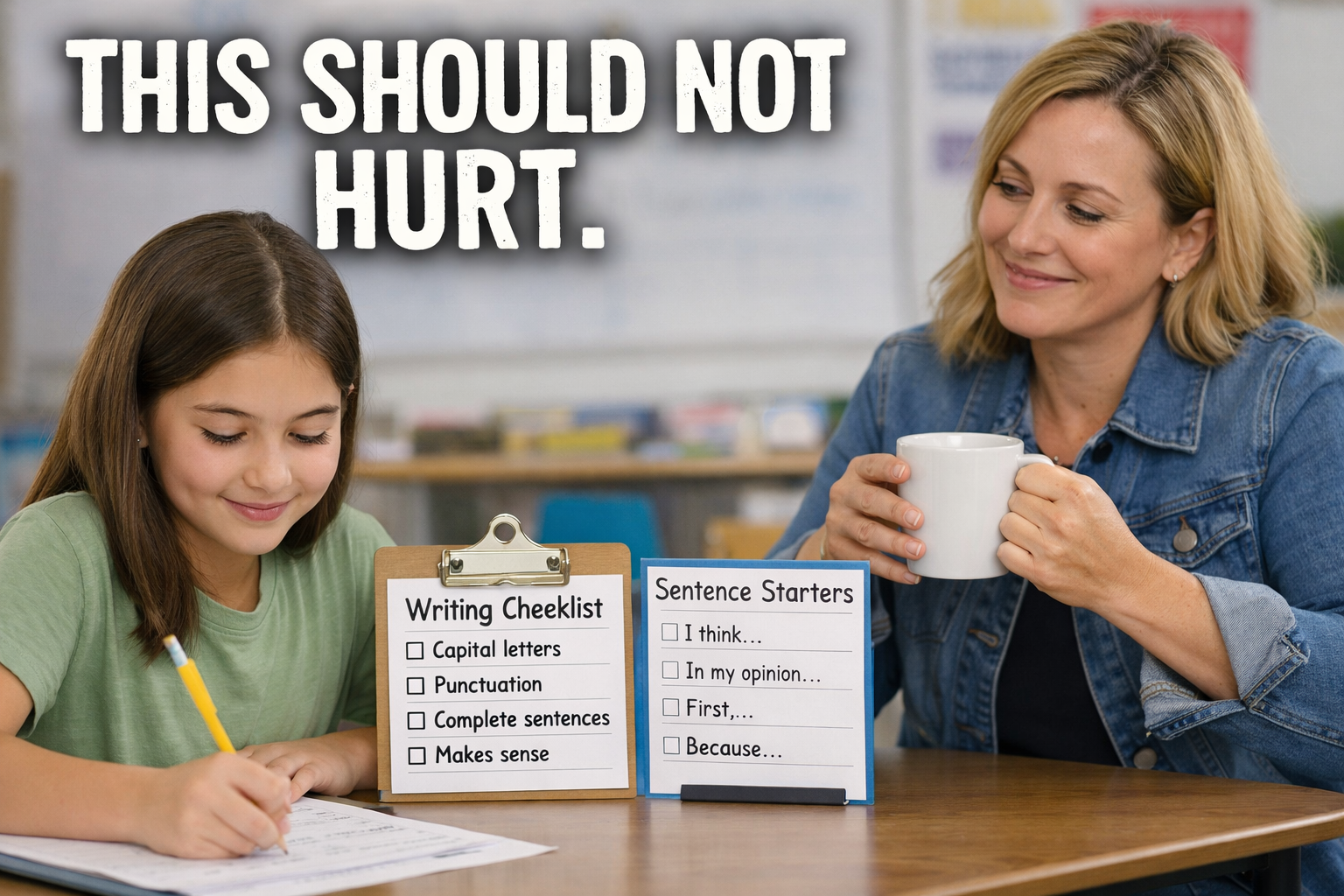
Templates are not lazy. They are efficient, equitable, and deeply supportive for language learners. A strong template removes the cognitive load of organization so students can focus on meaning. It also standardizes responses, which means your brain doesn’t have to reorient itself for every single paper.
When you reuse the same template across multiple assessments, students become more confident writers without you teaching new structures every time. That consistency builds fluency faster than novelty ever could.
Templates also make grading ridiculously faster. You know exactly where to look for evidence, and students know exactly what to produce. Everyone wins.
Prompts Should Feel Familiar, Not Clever
If a writing prompt feels clever to you, it’s probably confusing to your students. Writing assessments work best when prompts are boring, predictable, and deeply connected to class input. Students should already know the content, vocabulary, and structures before they ever start writing.
The goal is not originality. The goal is clarity. When students are writing from known language, they produce more accurate and confident output. That gives you better data and saves you from deciphering what they were “trying” to say.
Familiar prompts also help slower processors succeed without accommodations that feel obvious or stigmatizing. Everyone benefits from clarity.
Rubrics Should Reduce Decisions, Not Create Them
A good writing rubric eliminates judgment calls. If you find yourself staring at a paper thinking, “Well… kind of?” your rubric is doing too much. Effective rubrics describe observable behaviors using plain language and limited categories.
When you focus on what students can communicate rather than what they messed up, grading becomes faster and far more consistent. Students also understand their scores better, which reduces grade disputes and emotional emails.
Rubrics should feel almost boring to use. That’s how you know they’re working.
Feedback That Students Actually Read
Most students don’t want detailed written feedback. They want clarity. They want to know whether they’re on track and what to do next. That’s it. When feedback is concise and aligned to the rubric, students are more likely to engage with it.
Copy-paste comments, checklists, and highlighted phrases save enormous amounts of time without sacrificing effectiveness. One clear next step is more powerful than a paragraph of commentary that no one reads.
Your time matters. Spend it where it actually moves learning forward.
Writing Assessment as a System, Not an Event
When writing assessments are consistent in structure, expectations, and feedback, they stop feeling like special events and start feeling like part of the learning process. Students become calmer. You become faster. The entire system runs more smoothly.
This is exactly why so many teachers rely on tools like the CI Survival Kit at https://imim.us/kit. Having ready-to-use prompts, templates, and assessments removes decision fatigue and lets you focus on teaching instead of reinventing writing tasks every week.
And if you’re not sure where your own assessment practices fall on the CI spectrum, the CI Proficiency Quiz at https://imim.us/ciquiz is a quick way to find out. It gives you clarity about what you’re already doing well and where small shifts could make a big difference.
Final Thoughts: Less Pain, More Clarity
Writing assessments don’t need to be dramatic. They don’t need to be exhausting. And they definitely don’t need to steal your Sundays. When you simplify expectations, reuse structures, and focus on meaning over mechanics, writing becomes manageable again—for everyone involved.
You don’t need a total overhaul. You just need a few smarter decisions.
Five Key Takeaways
- Short, focused writing tasks give clearer proficiency data than long paragraphs
- Templates and sentence frames increase confidence and speed up grading
- Familiar prompts reduce anxiety and improve output quality
- Simple, boring rubrics create faster and more consistent grading
- Clear, minimal feedback is more effective than long written comments