Stop the Power Struggles: How Connection Fixes Behavior Fast
Stop the power struggles! Discover how “connection before correction” transforms behavior management, builds trust, and keeps your CI classroom calm, funny, and functional.

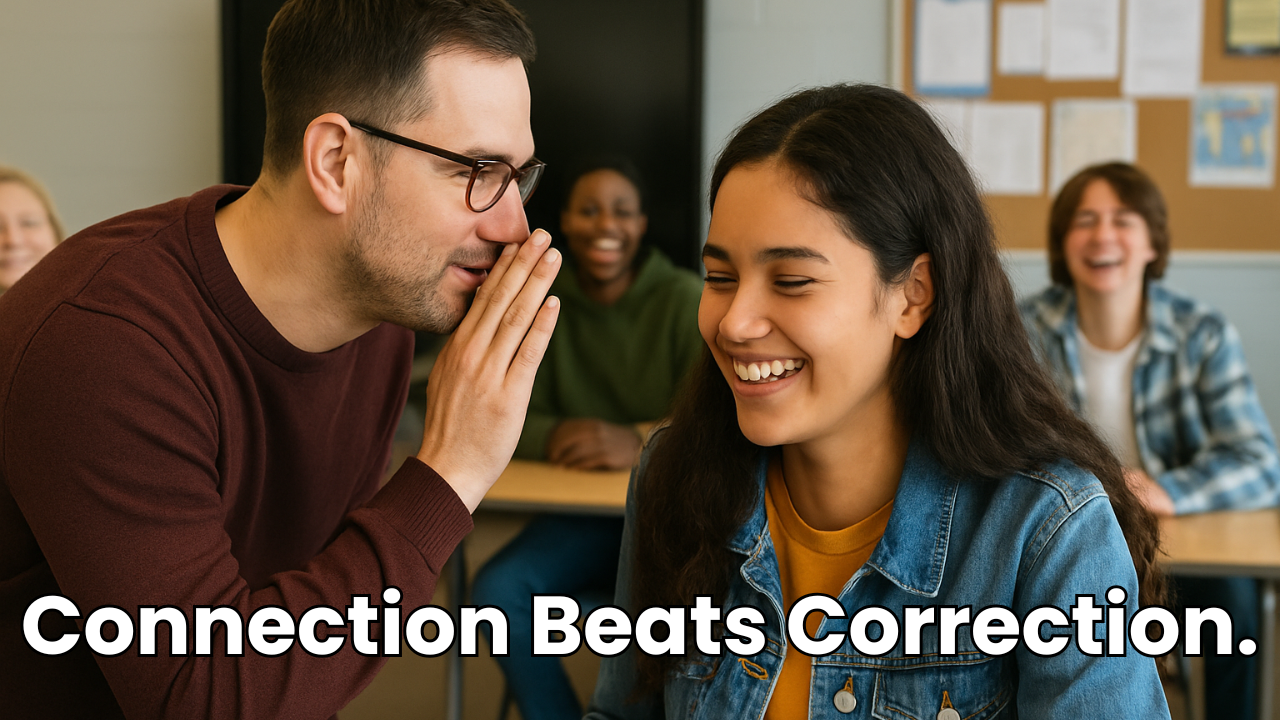
The Real Problem Isn’t the Kid—It’s the Disconnection
Let’s start with a confession: I’ve had classes that made me question every career decision since my high school guidance counselor told me I “had the heart of a teacher.” Cute.
But here’s what I’ve learned after years in the CI classroom: most behavior problems aren’t about defiance—they’re about disconnection.
When students feel unseen, unheard, or like you’re just another adult waiting to pounce, their walls go up faster than your blood pressure. You can have the perfect lesson plan, the most engaging comprehensible input, and still watch it all crumble if the trust isn’t there.
“Connection before correction” isn’t just a catchy slogan—it’s a survival strategy. And it’s easier than you think. Once you stop trying to control kids and start trying to connect with them, everything changes.
The Five-Second Rule for Teachers
No, not the one about eating dropped candy (although we’ve all done it in the prep room).
This is the Five-Second Pause — your secret weapon against power struggles.
When a student blurts out something ridiculous, drops a desk lid mid-silence, or tells you “this is boring,” your nervous system lights up like a Christmas tree. The instinct is to react. Fast. Loud. Authoritatively.
But here’s the thing: immediate correction almost always breaks connection.
When we respond from emotion instead of intention, we lose the moment.
So instead, pause for five seconds. Breathe. Channel your inner Profe Buddha. Look like you’re calmly recalculating your life decisions. That pause gives your brain time to switch from “fight” mode to “teach” mode.
You can even make it a game. One of my students once asked, “Profe, why do you always take a sip of coffee before answering us?”
I said, “Because caffeine and patience have a symbiotic relationship.”
Private Conversations Save Public Respect
Here’s a free professional development tip you won’t find in a district binder: correcting a student publicly is like trying to do CPR while yelling at the patient.
If you embarrass a student in front of their peers, you’ve just guaranteed they’ll double down to save face. Even if you’re right, you’ve lost the relationship—and the minute you lose connection, CI goes out the window.
Try this instead: the “Come Walk With Me” approach. Quietly invite them to step outside. Ask questions, not accusations. “Hey, you okay today?” works better than “Why are you acting like that?” because it implies care, not control.
I once told a kid, “You’re usually awesome, but today you’re acting like someone stole your Wi-Fi.” He laughed. The tension dropped. Problem solved.
Remember, you can correct behavior later—but you can’t undo public humiliation.
Humor: The Unsung Hero of Classroom Management
If laughter lowers the affective filter, then humor is basically a teaching superpower.
CI teachers already know that emotional engagement drives acquisition. Humor does that instantly. It connects without confrontation. When the energy in your room starts tipping toward chaos, don’t fight it—redirect it with a laugh.
Example: I once had a class that wouldn’t stop blurting. So, I declared it was time for the Blurter Olympics. Every blurt earned a dramatic tally mark under their name on the board. Gold medal went to whoever interrupted me the least. (Spoiler: nobody won.)
Or the time I renamed our phone caddy “Phone Jail.” I’d dramatically announce, “Your device has been sentenced to five minutes for crimes against productivity.”
Humor doesn’t diminish authority—it amplifies approachability. And in a CI classroom, approachability is everything. When students feel safe laughing with you, they’re safe learning from you.
Validation Is the Shortcut to Respect
Let’s talk about validation—the least sexy but most effective classroom skill you’ll ever develop.
When a student is upset, frustrated, or acting out, validation tells them, “You don’t have to fight to be heard here.” It’s the emotional version of turning off the alarm before it wakes the whole building.
Here’s how it sounds in real life:
- “I can see you’re frustrated. That test was rough.”
- “Yeah, Monday energy is real. We’re all just trying to survive.”
- “You’re not wrong—it is weird that we say ‘las manos’ instead of ‘los manos.’ Spanish is chaos.”
When students feel validated, they’re more likely to follow redirection because it doesn’t feel like rejection. You’re not fighting their feelings—you’re joining their team.
And if you can make them laugh while doing it? That’s the trifecta: empathy, humor, and power.
Repairing Relationships After Rough Days
Let’s be honest—sometimes even the calmest, kindest teacher loses it. You snap, sigh too loudly, or unleash The Tone™ that makes your students freeze mid-eye-roll.
Guess what? It’s okay. You’re human.
What matters isn’t the moment of frustration—it’s the follow-up.
Connection can be rebuilt faster than you think. The next day, start fresh. Say, “Yesterday wasn’t my best day. Let’s hit reset.” That one sentence models accountability, humility, and leadership—all at once.
Or try the Sticky Note Reset:
Leave a quick note on a desk: “Thanks for hanging in yesterday. Today’s going to be better.”
It’s tiny, it’s human, and it works.
Apologies don’t weaken your authority. They humanize it. And students who feel emotionally safe with you are ten times more likely to behave for you.
How This Fits Perfectly with CI
CI teaching thrives on emotional safety and shared joy. Students can’t acquire when their brains are in panic or defense mode. “Connection before correction” isn’t soft—it’s strategic.
When you lead with connection, you unlock the natural curiosity and humor that make CI powerful. Suddenly, your classroom shifts from discipline to discovery. From “Stop talking!” to “Tell me more—just in Spanish.”
That’s the dream. That’s the vibe.
Your Next Step
If you want to measure how strong your CI skills really are, take the free CI Proficiency Quiz. It’ll show you your strengths, your next growth areas, and maybe even confirm that you’re not crazy for caring this much.
And if you’re ready to ditch the prep panic and actually enjoy teaching again, the CI Survival Kit gives you ready-to-go lessons, readings, and stories in Spanish, French, and German — all built for connection-first classrooms.
Because at the end of the day, classroom management isn’t about controlling kids.
It’s about connecting with humans.
Key Takeaways
- Connection is 10x more effective than correction.
- Pause before reacting; calm is contagious.
- Private correction protects public respect.
- Humor and validation are the teacher’s best tools.
- Repair builds long-term trust (and sanity).