Boost Engagement Instantly: Music, Memes & Media Made Easy
Boost engagement instantly with music, memes, and media! Discover easy, hilarious, low-prep CI strategies that hook students, lower your workload, and bring your language classroom to life.

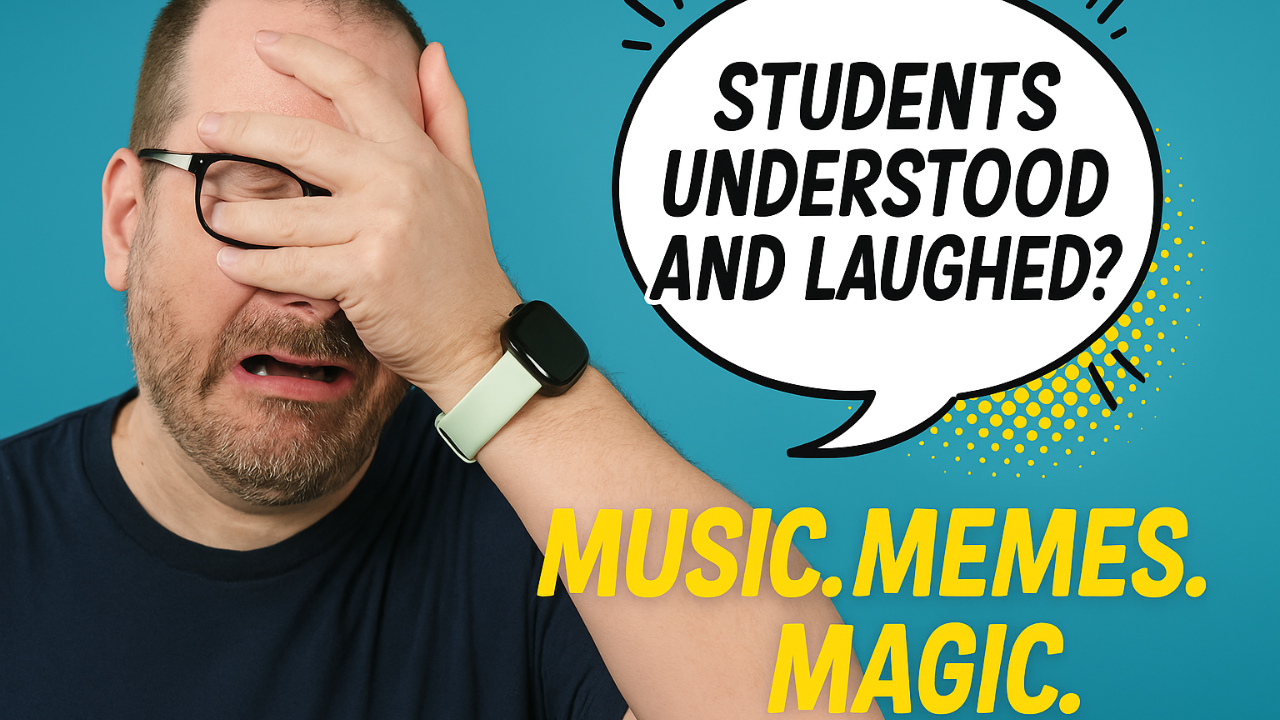
Because “more prep” isn’t the answer — more connection is.
When Engagement Feels Like a Myth
Let’s be honest: there are days when teaching feels like performing stand-up comedy for an audience that didn’t buy tickets, didn’t want to be there, and definitely isn’t laughing. You put in the work—your slides sparkle, your transitions are seamless, and your brain is humming with comprehensible input goodness. But your students? Zoned out. Phones out. Souls out.
It’s not you. It’s not them (well… maybe a little). It’s that traditional engagement strategies haven’t caught up with the way students interact with the world.
Today’s learners live in a dopamine-saturated landscape—memes, clips, trending sounds, and short bursts of connection. They process the world through humor, sound, and emotion. So why are we still trying to “hook” them with worksheets and grammar drills?
It’s time for something easier, faster, and way more fun: music, memes, and media. The triple threat that can take your language class from “Is it time to go?” to “Wait, that was kind of awesome.”
And the best part? You don’t need to be tech-savvy, funny, or even fully awake to make it work. You just need a little intentionality—and maybe some caffeine.
Why These Three Work: Science, Emotion, and Wi-Fi
Let’s get nerdy for a second (the fun kind of nerdy, not the data chart kind).
The human brain is wired to remember three things best:
- Emotion – what makes us laugh, cry, or cringe.
- Repetition – what we encounter often enough to stick.
- Novelty – what surprises or delights us.
Sound familiar? That’s literally the blueprint of the internet. And it’s also why music, memes, and media are perfect for language classrooms built on comprehensible input.
When students laugh, sing along, or react to a visual moment, their affective filter drops. That’s the barrier that blocks acquisition when anxiety or boredom creeps in. Once it’s lowered, input starts flowing freely—and students forget they’re even “learning.”
So no, these aren’t gimmicks. They’re scientifically sound and emotionally resonant tools. They’re the 21st-century equivalent of the campfire story—shared, memorable, and meaningful.
1. Music: Turning Noise Into Neural Gold
There’s a reason every language textbook ever printed includes a song section that everyone skips. Songs, when used right, can supercharge acquisition.
Music connects rhythm, emotion, and pattern—all of which reinforce language structure in ways drills never will. That’s why your students can’t remember your beautiful explanation of gustar, but they can sing “me gusta la gasolina” word-for-word fifteen years later.
How to Start Small (and Stay Sane)
Start with one song a week—nothing epic. Pick something catchy, appropriate, and repetitive. Your goal isn’t to analyze poetry; it’s to build comfort with sound and rhythm.
Step 1: Clip it to 20–30 seconds. (Nobody wants the four-minute version. Not even you.)
Step 2: Play it once with no lyrics. Ask: “¿Qué escuchas?” or “Was hörst du?”
Step 3: Play it again with lyrics on-screen. Highlight chunks of language you’re working on.
Step 4: Let them react.
Ask questions:
—“¿Qué significa esto?”
—“¿Te gusta la canción o no?”
—“¿Qué palabra escuchas mucho?”
It’s that simple. And over time, they start internalizing structures like hay, tiene, quiere, and va through sound, not worksheets.
Profe Bonus Points: Make It a Class Playlist
Create a collaborative class playlist where students vote on favorites each month. (Spotify, YouTube, or even Google Slides links work great.)
Label it “La Banda de Español 2” or “French Bangers Only.” When students hear “their” song outside of class, it becomes a language anchor. And when they win the right to pick a Friday song, motivation skyrockets faster than your caffeine levels during finals week.
Advanced Move: Rewrite the Lyrics
Once they know a song, challenge them to rewrite the chorus using your current vocab or grammar theme. The results are usually chaotic, occasionally brilliant, and always hilarious. Bonus: you’ll never look at Despacito the same way again.
2. Memes: The Universal Language of Laughter
Memes are the currency of teenage communication. They’re short, visual, and dripping with subtext—and they travel faster than a student packing up at 3:59.
Memes are miniature stories, which makes them gold for comprehension-based instruction. They’re contextual, emotional, and 100% relevant. When students create or interpret memes, they’re not just “having fun”—they’re negotiating meaning.
Using Memes for Input
Start your Monday with a “Meme of the Week.”
Project a simple meme in the target language.
Ask: “¿Qué pasa aquí?” or “Pourquoi c’est drôle?” and listen to the chaos unfold.
Half of them will wildly misinterpret it. That’s okay—it’s language in motion. Guide the conversation with comprehension checks:
—“So who’s the joke about?”
—“What’s the word that makes it funny?”
—“What would you caption it?”
They’re reading, interpreting, discussing, and laughing—all while internalizing vocabulary and syntax naturally.
Creating Memes for Output
Then, flip the script. Give students a blank meme template. You can use classics like “Drake No/Yes,” “Distracted Boyfriend,” or “Change My Mind.” Ask them to caption it in the target language based on your current theme.
You’ll get gems like:
“When Profe says there’s a quiz but it’s a listening activity instead.”
or
“Cuando no hay tarea y Profe dice ‘¡buen trabajo!’”
Print them out and hang them on a Meme Wall of Fame. The pride (and language production) that follows is unreal.
Hot Tip: Make It Competitive
Have a “Meme-Off” every Friday. Each student presents one meme. The class votes for the funniest, most accurate, or most relatable. Winner gets a sticker, a candy, or eternal glory.
It’s low-prep, high-laughter, and full of CI goodness.
3. Media Clips: Micro-Moments with Macro Impact
Media clips are the modern-day text. Commercials, TikToks, YouTube Shorts—these are microbursts of language and culture wrapped in attention-grabbing packaging.
Students are already fluent in decoding this kind of content. They understand tone, timing, and humor. All you have to do is add comprehensible input framing.
Using Clips for Listening Comprehension
Find a short clip (under one minute) that connects to your current theme—something visual, funny, or emotional.
—A dog stealing pizza.
—A grandma dancing.
—A commercial for chocolate.
Play it once with sound. Ask: “¿Qué viste?”
Then again with subtitles in the target language. Pause and discuss.
Finally, mute it and let them dub it live.
Yes, it will descend into chaos—but glorious, learning-rich chaos. Students are using natural phrasing, testing vocabulary, and negotiating meaning in real time.
Prediction Power
Pause mid-clip and ask: “¿Qué pasa después?” Let them guess. Then play the rest and laugh together. That prediction step adds anticipation, meaning, and repetition—all core CI elements.
Reuse = Relief
Save these clips in a “CI Media Bank.” Once you’ve built a small library, you can reuse them every year. The prep never grows; the impact always does.
4. Student-Created Content: Engagement That Builds Itself
When students create, they remember. The act of producing content based on input is the holy grail of acquisition—it solidifies language naturally.
Ask your students to create 15–30 second skits, meme videos, or “mini commercials” in the target language. Give them structure:
“Describe your weekend like it’s a dramatic movie trailer.”
“Make an ad for a product nobody needs.”
“Film a meme in real life.”
The laughter that follows? That’s acquisition with volume.
Classroom Magic: The Showcase
End each week with a “CI Premiere Day.” Show their clips. Celebrate creativity. You’ll see students who were disengaged all week suddenly light up because their video got laughs.
Make it a monthly event. Add popcorn. Let students host. The result: authentic input, creative output, and a community of learners who can’t wait to see what’s next.
5. The Low-Prep Philosophy: Do Less, Teach More
Here’s the secret sauce: you don’t need to constantly reinvent content. You just need to remix it.
Keep a CI Arsenal Folder with:
- 10 songs (for rotation)
- 10 memes (with blank templates)
- 10 short videos (for recurring themes)
Then reuse them across tenses, topics, or skill levels. One week it’s vocabulary, the next it’s cultural analysis, and the next it’s storytelling. The content stays the same—your focus changes.
That’s not laziness. That’s efficiency.
Call it “spiraling input.” Call it “curriculum scaffolding.” Call it “teacher survival.” Whatever works.
How to Sustain It
The trick to sustaining engagement is rhythm. Build these into your week like rituals:
- Meme Monday
- Tune-In Tuesday (a short song or lyric)
- Film Friday (a clip, a laugh, and reflection)
Once students know what to expect, they lean in. And once you know what to expect, you breathe easier. Predictability is power—for both sides of the desk.
Beyond Engagement: Building Connection
Music, memes, and media do more than engage—they build community. They give students inside jokes, shared experiences, and a reason to show up even on the hard days.
When a student quotes your meme wall or hums last week’s song, that’s connection. When they use a phrase from a clip in conversation, that’s acquisition.
And when they laugh while doing it—that’s magic.
Real Talk: What About Admin, Parents, and Data?
If anyone questions whether these strategies “count” as academic, smile politely and hand them this argument:
- Students are interpreting authentic input.
- They’re producing meaningful language.
- They’re demonstrating comprehension.
- You have built-in formative assessment every time you pause to discuss.
And yes—engagement is measurable. Try this: before implementing one of these strategies, ask your class to rate their “interest in Spanish” on a scale of 1–10. Do it again two weeks later. You’ll see the difference.
The Big Picture: Fun Is Serious Business
The most powerful learning happens when joy meets purpose. Music, memes, and media aren’t distractions—they’re the delivery system for meaning.
Your students aren’t lazy. They’re just tired of being disconnected from what they love. When you meet them where they already live—online, emotionally, and humorously—you create something that lasts.
And honestly? You deserve to have fun, too. Teaching is too hard to be miserable. If adding a 30-second meme discussion or a 20-second song clip makes your day lighter and your students’ smiles brighter, that’s a win.
Next Steps: Your CI Glow-Up
If you’re ready to measure your CI superpowers and find out what’s already working (and what could work better), take the CI Proficiency Quiz. It’s quick, free, and surprisingly accurate—kind of like a BuzzFeed quiz but for language nerds.
And if you’re tired of scrambling for resources, grab the CI Survival Kit. It’s your monthly stash of done-for-you stories, slides, readings, and assessments in Spanish, French, and German. Think of it as your CI autopilot.
Because the goal isn’t just to survive—it’s to thrive (and maybe laugh a little on the way).
Key Takeaways
- Music, memes, and media are scientifically proven CI boosters.
- Humor and emotion create lasting language connections.
- Let students create to deepen comprehension and ownership.
- Reuse materials across topics—it’s smart, not lazy.
- Engagement isn’t extra—it’s everything.