A Speaking Assessment Routine That Stays Calm Every Time
Speaking assessments are where good intentions go to die. Not because speaking is bad. Not because students shouldn’t speak. Not because CI teachers are secretly allergic to interpersonal communication. It’s because speaking assessments have a special talent for turning your classroom into a low-budget reality show: half the

Speaking assessments are where good intentions go to die.
Not because speaking is bad. Not because students shouldn’t speak. Not because CI teachers are secretly allergic to interpersonal communication. It’s because speaking assessments have a special talent for turning your classroom into a low-budget reality show: half the class panicking, three kids auditioning for stand-up comedy, two kids whispering in English like it’s a spy mission, and you… trying to grade while also preventing someone from spinning in a chair like a helicopter.
And it’s not your fault.
Most of us were handed one of two models for “speaking tests,” and both are chaos in different outfits. Model A is the “everyone performs in front of the class” version, which is basically stage fright plus peer judgment with a sprinkle of trauma. Model B is the “I’ll call you up one at a time while everyone else ‘works quietly’” version, which assumes 35 teenagers will sit in silence without supervision because you asked nicely.
So teachers avoid speaking assessments, or they do them once and vow never again, or they do them and spend the whole time thinking, “There has to be a way to do this without losing a year off my life.”
There is.
A calm speaking assessment isn’t about luck, personality, or having “good kids.” It’s about routine. It’s about predictability. It’s about designing the assessment like a CI lesson: structured, comprehensible, repetitive, and not dependent on everyone making excellent choices at the same time.
This article is a step-by-step routine you can use again and again. It’s built for real classrooms, real time constraints, and real students who are wonderful and also… teenagers.
Bold truth: If your speaking assessment feels chaotic, it’s almost always a procedure problem, not a student problem.
Let’s build the procedure.
1) Predictability Prevents Chaos
If you want calm, you have to remove surprise.
Surprise is fun at birthday parties and on game shows. Surprise is not fun when you’re asking students to produce language in front of peers while you attempt to evaluate them like a reasonable adult.
The fastest way to reduce chaos is to make your speaking assessment routine so consistent that students could run it without you. (They won’t, but the point is they could.)
Start by locking in a format you will reuse. Same steps. Same timing. Same roles. Same “this is what we do when we speak for assessment” rhythm every single time. Students feel calmer when they know what’s coming, and you feel calmer because you’re not explaining a brand-new system like you’re narrating IKEA instructions.
A simple structure that works beautifully is “Round-Based Partner Speaking.” Students speak in short rounds with a visible timer, then rotate or switch roles. The consistency becomes the management.
Here’s what predictability looks like on the ground: you put one slide up that never changes except the prompt. It lists the steps. It shows the timer. It tells them exactly what to do when they finish early (because they will finish early, and if you don’t plan for that, they will invent something).
Make the procedure the same, and only swap the prompt. That’s the whole magic trick.
A few practical moves that keep this calm:
- Use the same seating plan or partner system each time so you aren’t spending 10 minutes on “Find a partner” (the anthem of wasted class time).
- Build a consistent “voice level expectation” that you practice (not just announce).
- Decide ahead of time how you handle absent students, non-participation, and “My partner is gone” situations, because those three things will happen approximately forever.
A calm speaking assessment is basically a CI routine with a clipboard.
2) Keep the Speaking Tiny on Purpose
One reason speaking assessments explode is because we ask for too much output at once.
We say things like “Have a conversation for five minutes,” which sounds fine until you remember that many students can’t sustain five minutes of target-language conversation unless you’re feeding them structure, support, and encouragement like a life coach.
Short speaking tasks are not “less rigorous.” They are more accurate. They let you measure what students can actually do without endurance, anxiety, or social dynamics hijacking the data.
Aim for 20–45 seconds per student per round. That’s long enough to show comprehension and communication, short enough to avoid spiraling. If you want more evidence, do more rounds—not longer rounds. Multiple short rounds are calmer and give you better sampling.
Also, keep the prompt tight. One prompt. One response. One follow-up question. Done.
For example, instead of “Talk about your weekend in detail,” you do “Say what you did + where + with who.” That’s still communicative. It’s still meaningful. It’s just… possible.
Short tasks also solve the “fast finisher chaos” problem. When students have a small target, they finish at roughly the same time, and your room stays synchronized.
A few options for tiny speaking prompts that stay focused:
- One statement + one reason (“I like ___ because ___.”)
- One description + one detail (“My room is ___ and it has ___.”)
- One past action + one reaction (“I went to ___ and it was ___.”)
- One preference + one comparison (“I prefer ___ to ___.”)
And yes, you can still assess proficiency growth with short tasks. In fact, short tasks make proficiency clearer because the output is less padded by filler.
If your speaking task needs three paragraphs of directions, it’s not a speaking task—it’s an escape room.
3) Use Stations and Roles Instead of Hoping for “Good Behavior”
A speaking assessment runs on traffic control.
If your plan is “Everyone talk at once and I’ll float around,” you’re going to float around like a person trying to put out 12 small fires with a spray bottle.
Instead, design the room so movement and noise are expected, structured, and limited.
Stations are your friend. Not the complicated Pinterest version. Just “these pairs speak here, and these pairs speak there, and we rotate when the timer says so.”
Even in a normal classroom, you can create a station feel with simple zones: left side, right side, front corners, back corners. The point is that students have a place and a purpose, not an open-ended wandering situation.
Roles also reduce chaos because they remove ambiguity. If both students are supposed to “have a conversation,” one will dominate and the other will vanish. If one student is Speaker A and the other is Speaker B, and they switch on the timer, the participation becomes automatic.
Here’s what a calm round can look like:
- Round 1: Student A answers prompt while Student B listens and asks one follow-up.
- Round 2: Switch roles with a new prompt or a twist on the same prompt.
- Round 3: New partner or new station if you want variety.
Your job becomes monitoring and collecting evidence, not refereeing.
This is also where a “help menu” slide saves your soul. Put sentence starters, question stems, and repair phrases in one visible place so students don’t need you every time they forget a word. They’ll still ask you anyway because that’s who they are, but it drops the frequency.
Helpful supports that keep the room calmer:
- Sentence starters (so they don’t freeze at the start)
- Question stems (so follow-ups exist)
- Repair phrases (“Say that again,” “What does ___ mean?”)
- A “What to do if finished” instruction (repeat with a new detail, ask the follow-up, switch roles)
You’re not grading a conversation. You’re grading what they can do with support, because that’s real communication.
4) Grade Less, More Clearly, With One Simple Rubric
Most speaking assessments become chaotic because the teacher tries to grade too many things at once.
You’re listening for vocabulary, grammar, pronunciation, fluency, creativity, eye contact, confidence, and whether they look like they’re trying. That’s not assessment; that’s a documentary.
Pick one main thing to assess per round. If you want more, do multiple rounds across days.
A practical approach is to assess comprehensibility first. Can the student be understood? Are they communicating meaning with the language they have? That’s the CI sweet spot.
Then build a rubric that you can apply in three seconds. If you can’t apply it fast, you won’t use it consistently, and then the assessment becomes stressful for everyone.
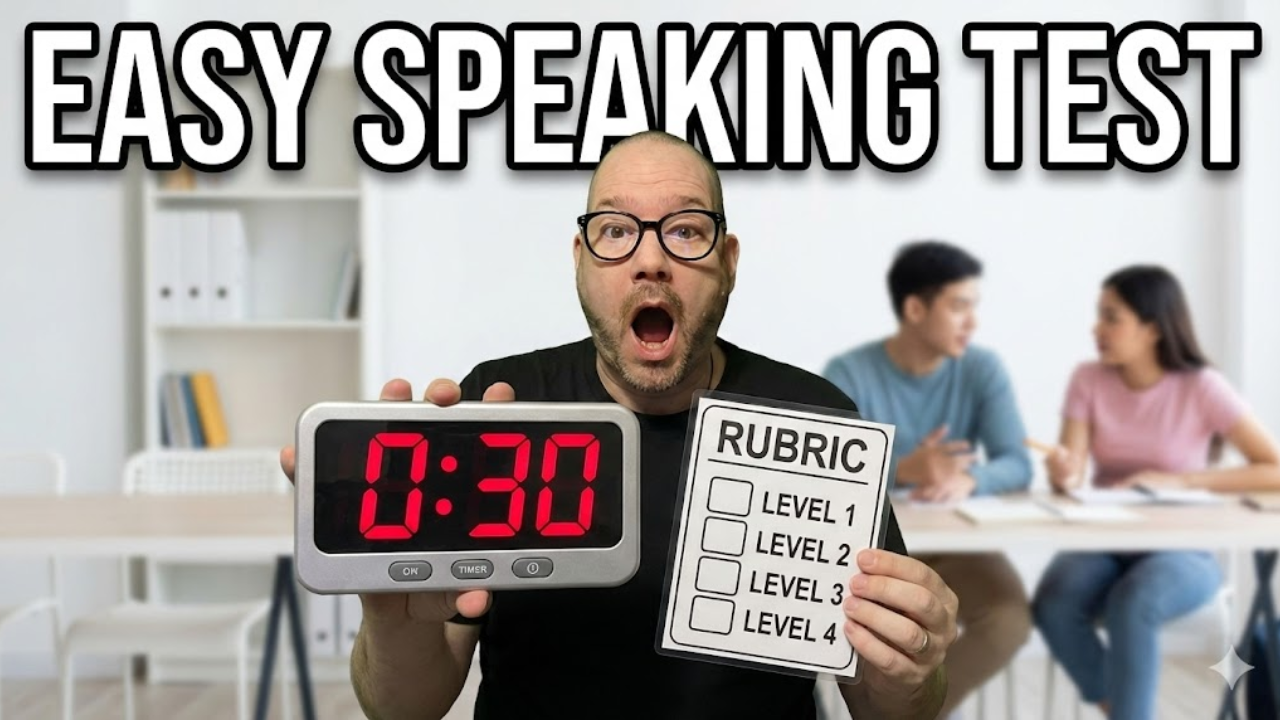
A simple four-level rubric works well:
- Level 4: Understandable, complete message, stays in target language with minor gaps
- Level 3: Mostly understandable, message present, some support needed
- Level 2: Partially understandable, fragments, frequent breakdowns
- Level 1: Not yet, minimal output or not comprehensible
You can also add a separate “participation/procedure” check if your gradebook needs it, but keep the language score focused.
How do you collect evidence without going insane? Use a grid. Write names down the side, rounds across the top, and mark quickly. You’re not writing feedback novels in the moment. You’re collecting quick snapshots.
And here’s a secret: your students benefit when your rubric is simple because they can understand it. They know what you’re looking for. They can aim for it. They can improve.
5) Train the Routine All Week So the Assessment Feels Like Class
If the first time students encounter your speaking format is during the assessment, it will feel scary, confusing, and chaotic. Not because they’re dramatic (okay, sometimes) but because the brain doesn’t love new procedures while performing.
So the solution is simple: make the assessment format feel like a normal class routine.
During the week, do tiny speaking reps that match the assessment steps. Same partner roles. Same timer. Same follow-up question. Same expectations. When the assessment arrives, it feels like “Oh, we’re doing the thing we always do,” not “Surprise performance day!”
This is also where you build repair phrases as a classroom culture. Students need language for when communication breaks down. Without it, they panic, switch to English, or freeze. With it, they can keep going—even with imperfect language.
Useful repair phrases to train:
- “Say it again, please.”
- “What does ___ mean?”
- “How do you say ___?”
- “I don’t understand.”
- “Do you mean ___?”
When students have those tools, your speaking assessment becomes calmer because communication has a safety net.
A classroom that practices short speaking regularly will treat speaking assessments as normal. A classroom that never practices speaking and then suddenly gets graded on speaking will treat it like the apocalypse.
If you want calm speaking assessments, normalize speaking before you grade it.
How to Start Tomorrow
You don’t need a new curriculum. You need a routine you can repeat.
Start tomorrow with this exact plan.
First, choose one prompt connected to what you’re already doing in class. Keep it narrow: one statement plus one detail or one reason. Put it on a slide along with sentence starters and question stems.
Second, assign partners in a predictable way. Don’t burn time on “find someone.” Use your seating chart, your clock partners, or “A and B” partners.
Third, explain the roles and practice the procedure with a silly English prompt for one round so they learn the steps without language anxiety. Then switch to the target language prompt.
Fourth, set a visible timer for 30 seconds. Student A speaks, Student B listens and asks one follow-up. When time is up, switch roles.
Fifth, walk with a clipboard grid and mark quick scores. Don’t chase perfection. Collect evidence.
Here’s your quick checklist:
- Put up the prompt + supports
- Set roles (A speaks, B follows up)
- Timer on screen
- Two rounds minimum
- Mark a quick rubric score per round
- End with a calm “done” procedure (turn in reflection slip or sit silently)
If you do this once, you have the framework forever. Next time, you swap the prompt and reuse the same routine.
Speaking assessments don’t have to be chaotic. They become chaotic when they are unpredictable, too long, too vague, and too dependent on students magically knowing what to do.
A calm speaking assessment is built the same way a strong CI lesson is built: clear structure, repeated routines, high support, and manageable chunks.
When you make the format predictable, keep the speaking short, control movement with roles and stations, simplify the rubric, and practice the routine during the week, you get a speaking assessment that actually measures communication instead of measuring anxiety.
You also get something else, which is underrated: you get your peace back.
And you deserve that.
Try this routine once this week with a tiny prompt and two quick rounds, then reuse the same structure the next time you assess speaking. You’re not looking for perfection—you’re building a system you can actually sustain.
Five Key Takeaways
- Predictable routines make speaking assessments calmer and more accurate
- Short speaking rounds beat long “conversation tests” every time
- Stations and roles control movement and reduce off-task chaos
- A simple rubric you can use fast is better than a perfect rubric you can’t
- Practice the procedure during the week so the assessment feels familiar